

Content Advisory: This article discusses diet culture, dieting, disordered eating, racism, anti-Black racism, slavery, starvation, medical racism, and fatphobia alongside other difficult topics. Please read with care. Click here for resources if you could use support.
Eating Disorder Awareness Week is February 1-7, 2026. This year's theme is "Health doesn't have a look". We’re inviting our community to challenge the harmful belief that thinness equals health.
We spoke with Julia Klassen, a counsellor in the Provincial Eating Disorder Prevention and Recovery Program here at Women’s Health Clinic (WHC), to learn more about the roots of diet culture, how it might be sneakily popping up in our lives, and how we can resist with self-compassion.
What is diet culture?
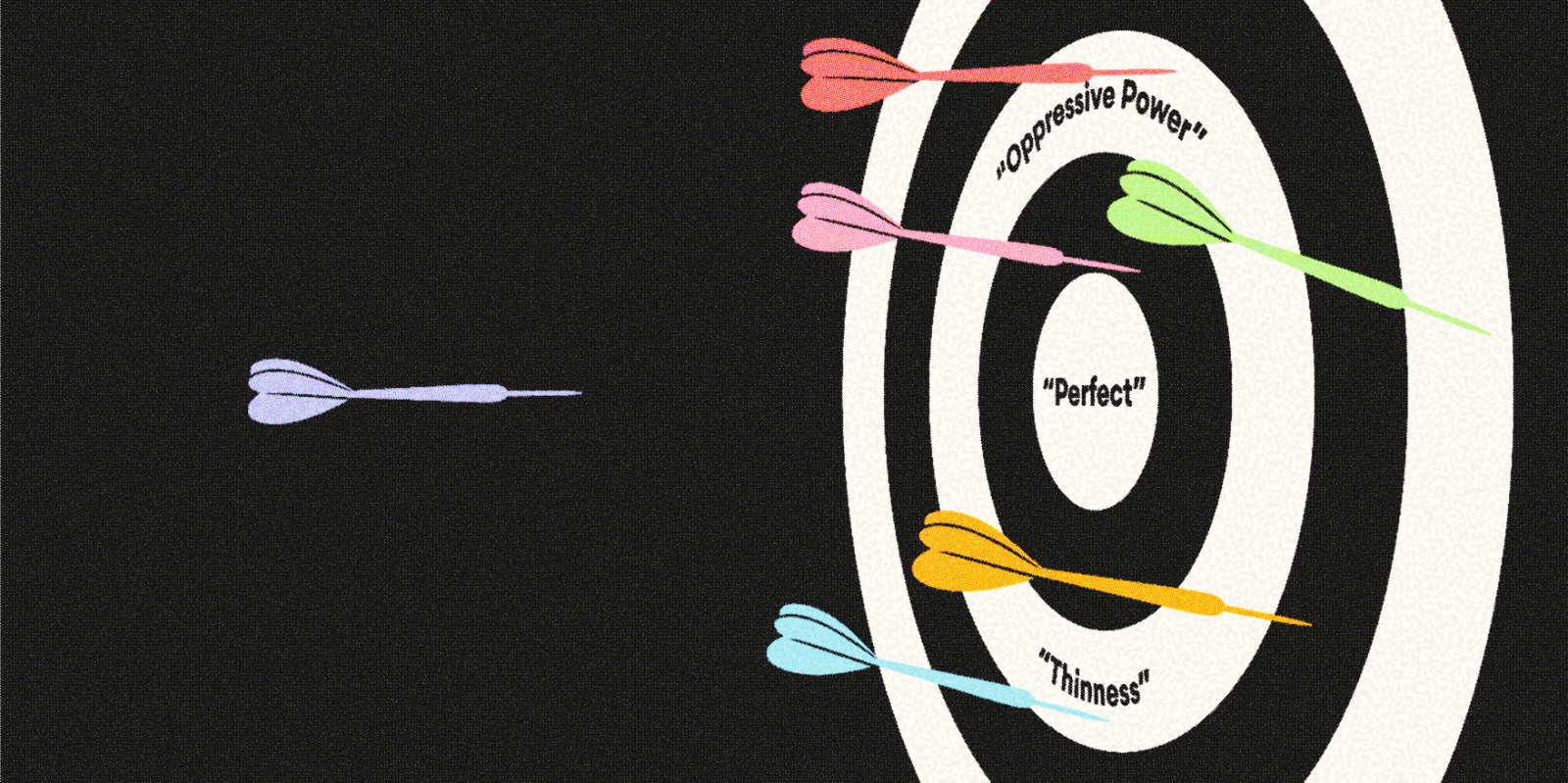
Diet Culture goes beyond the prevalence of fad diets, the encouragement of food restriction, or critical body talk. “Diet culture is a system of beliefs that worships thinness and equates it to health and moral virtue. It promotes weight loss as a means to attaining higher status,” says Klassen. “Diet culture demonizes certain ways of eating while elevating others and oppresses people who don't match up with this picture of health.”
She explains that diet culture disproportionately targets and harms people already facing marginalization: women, femmes, nonbinary people, trans folks, people in larger bodies, Indigenous people, Black people, people of colour, and people with disabilities.
However, nobody is exempt from the influences and harms of diet culture, Klassen points out. “While diet culture especially targets marginalized populations, it most definitely still impacts people with privilege, including men and masculine people,” she says. “The omission of this group in the conversation about culture can be really harmful. Diet culture affects everybody, just in different ways.”
When Did Diet Culture Start?
Klassen says there are many different documented instances of people changing what they eat or the way they move their bodies to change their appearance. She cites scholar Sabrina Strings’ Fearing the Black Body: The Racial Origins of Fat Phobia as finding the origins of what we’d recognize as modern diet culture’s beginnings to the transatlantic slave trade.
During the height of the renaissance, larger body types were praised as ideal. At a time when most Europeans were peasants who performed manual labour, large, pale bodies represented something to aspire to – the wealth and status to eat plenty and rest inside instead of toiling outside in the sun.
The transatlantic slave trade grew, and colonization expanded its footprint throughout Africa towards the end of Renaissance Era. This led to a proliferation “race scientists” who espoused the theory that there were distinct biological differences between white Europeans and enslaved Black folks. They proposed these ideas that white folks were logical, rational, and self-controlled, while Black folks were lazy, sensuous, and gluttonous.
By the beginning of the 18th century, Klassen says these ideas spread throughout Europe. At the same time, Sabrina Strings points to the more frequent existence of biracial people.
“In the beginning of the slave trade; it was simply skin color. […] After 200 years of [Black people and white people] living in close proximity, skin color really no longer works as a mechanism, right? Because now we have all of these people who […] we would consider today to be biracial,” Strings said in an interview with NPR.
To keep their oppressive power, the ruling class needed a mechanism to make it easier to determine who was free and who was enslaved. Strings says that the solution was to push these non-scientific beliefs to invent further aspects of racial identity.
“Eating and body size became two of the characteristics that were being used to suggest that these are people who do not deserve freedom,” said Strings.
Klassen says that Western body ideals still reflect this biased viewpoint. “Thinness and whiteness were pushed as being superior and it's undeniable that we can still see this belief system today. It’s deeply disturbing, but really important to acknowledge these origins.”
Why Do Body Ideals Change Over Time?
While smaller bodies have still been a fixation for centuries, there have been changes to the ideal way to have a smaller body over time. Different proportions or features may have been idealized, but the thing that stays the same: the target of ‘perfect’ is always moving.
“There's money to be made when people feel like they need to change their bodies,” says Klassen. The weight loss industry alone – not including new weight loss prescription drugs – is valued at around $76 billion USD. When you consider the beauty industry, plastic surgery industry, and all other industries that make their money off our striving to look ‘perfect’, there is plenty of profit to be made.
“Capitalism and the flow of money relies heavily on body shame and feeling like our bodies are not okay as they are. If we all feel like we're okay, these systems don't exist. They would just fail to thrive.”
What Effects Does Dieting and Diet Culture Have On Us?
Physical or ideological restriction of food (‘I shouldn’t have this food, it’s bad/unhealthy’) can have serious physical and mental side effects. “Dieting is when we eat less than our bodies need,” says Klassen. “There are physical symptoms that come with restricting: feeling more tired and more fatigued.”
Klassen says that when we're chronically hungry, like with sustained dieting, our emotional wellness can be a lot more easily dysregulated.
“There’s mood destabilization, anxiety, depression, and really fixating on food. People describe that their life starts to shrink because of their fixation on food and body starts to grow and it takes up so much mental real estate.”
When it comes to the big picture of diet culture’s effects, Klassen points out what is lost when people are asked to fixate on weight. “There’s lots of good we could be focusing our energy on instead. Think of the impact diet culture and focusing on our weight has societally.”
Why Do People Try and Uphold These Ideals?
So, with these physical and mental side effects, why do people try and diet to uphold these ideals? Klassen invites us to use curiosity and a non-judgmental lens when trying to understand why people engage in diet culture.
“Adherence to societal norms or appearance ideals, of course, allows for a certain level of privilege and ease to move through the world – even beyond body size,” says Klassen. “It can offer a sense – or a reality – of safety in a world that treats many different groups very poorly.”
Klassen points to specific ways that larger bodies are not considered or left out: bias in medical care or medical fat phobia, the shrinking size of airline seats, and restaurant seating that does not accommodate larger bodies. There’s weight bias in workplaces and hiring practices that leave people in larger bodies economically disadvantaged.
“There are no shortages of examples where we can see tangible anti-fatness in our society,” says Klassen.
“It makes sense that people would feel motivated to try to change their bodies in order to fit into a world that tells them that something's wrong with their body, that their body is the problem.”
What if I’m Just Trying to Be Healthy?
While diet culture focuses on body size and shape for aesthetic reasons rooted in oppressive ideals, many larger people are told they should focus on shrinking their bodies for the sake of their health. What if the pursuit of body change is about wellness?
“The cruel irony of dieting is this: dieting leads to diet cycling,” says Klassen. Weight loss is rarely permanent and often leads to diet cycling. Also known as ‘yo-yo dieting’ refers to a constant cycle of restriction, followed by a return to typical eating patterns, followed by shame for ‘failing’, and re-starting the cycle by restricting again.
“This cycle can actually lead to more poor health outcomes than maintaining what society might say is a ‘higher weight’,” says Klassen. Weight cycling can lead to increased risk of cardiovascular issues and mortality completely unrelated to the person’s size. Type 2 Diabetes risk also increases with weight cycling, again, regardless of someone’s weight.
Whether it’s labelled as a diet or as ‘wellness’ or a ‘lifestyle change’, Klassen says that this differentiation in language doesn’t matter if we’re choosing restrictive ways of eating and living. There is nothing wrong with wanting to be well.
But Klassen encourages us to be curious and honest about the behaviours that we’re engaging in. Is that ‘lifestyle change’ eating less? Is it controlling your food in any way? Is it cutting out large groups, food groups that you previously really enjoyed? Is it sustainable?
“I say this with compassion: if you're eating less, if it's restrictive in any way, and it's not sustainable? It's a diet,” she says.
“People can choose whether or not they want to engage in that. But what's unfair is that they're not being given all of the information and then they are the ones made to feel like a failure when it doesn't ‘work’,” says Klassen.
What Can I Do When I See Diet Culture Popping Up in My Life?
“We can't always remove diet culture entirely from our lives, but we can check in with how it impacts us and how we can reframe or push back on those beliefs within ourselves,” says Klassen.
She suggests small actions like reminding ourselves that ‘all foods fit’, noticing when we start labelling foods ‘good’ or ‘bad, or paying attention to people using language around food that doesn’t fit with our worldview and reflecting on it.
“Diet culture is a culture—we often call it ‘the water that we swim in’. So, it has the ability to be so insidious and it changes and morphs over time,” says Klassen.
Once we start to notice the pattern, we can label and categorize these thoughts and attitudes, lessening the control that diet culture has on us.
Klassen also hopes understanding how long diet culture has been around and how deeply intertwined with other systems of oppression it is can inspire self-compassion.
“It can feel heavy to realize the depth of diet culture’s impact and seeing how it affects us individually,” Klassen says. “It is not our fault that we may struggle with relationship to food and body. It's actually very strategic from an early age.”
The Antidote to Diet Culture
Seeing how deeply embedded diet culture and fatphobia are in our society, in our language, in our thoughts—how can we push back?
Klassen suggests finding refuge and reinforcement in community. “Find those safer spaces and people who share similar beliefs around being more body neutral, weight neutral, or anti diet. If you don't have them in real life, they do exist online, too. Finding those spaces to gain momentum and connect to can be helpful.”
“From there, we can also decide to move into some action around boundaries we can personally have in place around diet culture,” she says.
She suggests actions inspired by the work of Sonya Renee Taylor in her book The Body is Not an Apology: The Power of Radical Self-Love. Taylor says “We cannot build externally what we have not built internally”.
“So how can I create a diet-free world internally?” Klassen asks us to ask ourselves. “That has a ripple effect in our relationships and in our communities. I truly believe that. I've seen it, lived it. There's lots of hope.”
Want to learn more skills to help you fight back against diet culture?
Click here for upcoming workshops offered by WHC's Provincial Eating Disorder Prevention and Recovery Program.
To learn more about the Provincial Eating Disorder Prevention and Recovery Program and to receive support for disordered eating, click here.
Additional Resources, Recommeded by Julia:
Study From education to patient care: the impact of weight stigma in healthcare - PMC
Video Sonya Renee Taylor Tells Us Why Self-Love Should Be Radical
Video Sabrina Strings Explains How 'Fatphobia' is Rooted in Racism
Resource Dr. Sand Chang – Diet Culture, Oppression, Queer Eating Disorder Recovery